
Compare Models
| Essentials | REMOVEMacBook | REMOVEMacBook Pro |
| Image |
 |
 |
| Family | MacBook | MacBook Pro |
| Codename | ? | ? |
| Gestalt ID | 406 | 406 |
| Minimum OS | 10.4.6 | 10.4.4 |
| Maximum OS | 10.6.8 | 10.6.8 |
| Introduced | May 2006 | January 2006 |
| Terminated | November 2006 | October 2006 |
| Processor | REMOVEMacBook | REMOVEMacBook Pro |
| CPU | Intel Core Duo (T2xxx) | Intel Core Duo (T2xxx) |
| CPU Speed | 1.83/2.0 GHz | 1.83/2.0/2.16 GHz |
| CPU Cores | 2 | 2 |
| FPU | integrated | integrated |
| Bus Speed | 667 MHz | 667 MHz |
| Register Width | 32-bit | 32-bit |
| Data Bus Width | 32-bit | 32-bit |
| Address Bus Width | 32-bit | 32-bit |
| Level 1 Cache | 32 kB data, 32 kB instruction | 32 kB data, 32 kB instruction |
| Level 2 Cache | 2 MB on-processor | 2 MB on-processor |
| ROM | EFI | 1 MB ROM + 3 MB toolbox ROM loaded into RAM |
| RAM Type | PC2-5300 SO-DIMM | PC2-5300 SO-DIMM |
| Minimum RAM Speed | 667 MHz | 667 MHz |
| Onboard RAM | 0 MB | 0 MB |
| RAM slots | 2 | 2 |
| Maximum RAM | 2 GB | 2 GB |
| Expansion Slots | 1 ExpressCard/34 | |
| Video | REMOVEMacBook | REMOVEMacBook Pro |
| Screen | 13.3" active matrix TFT | 15.4" active matrix TFT |
| GPU | Intel GMA950 | ATI Mobility Radeon X1600 |
| VRAM | 64 MB shared (see notes) | 128/256 MB GDDR3 |
| Max Resolution | 1280x800 | 1440x900 |
| Video Out | mini-DVI | dual-link DVI |
| Camera | iSight | iSight |
| Storage | REMOVEMacBook | REMOVEMacBook Pro |
| Hard Drive | 60/80 GB 5400 RPM (w/SMS) (100/120 GB 5400 rpm BTO) | 80/100 GB 5400 RPM (w/SMS) (120 GB 5400 rpm or 100 GB 7200 rpm BTO) |
| ATA Bus | Serial-ATA | Serial-ATA |
| Optical Drive | 24x/24x/10x/8x/4x/4x CD-RW/DVD±RW | 24x/24x/10x/8x/4x/4x CD-RW/DVD±RW |
| Input/Output | REMOVEMacBook | REMOVEMacBook Pro |
| USB | 2 2.0 | 2 2.0 |
| Firewire | 1 | 1 |
| Audio Out | stereo 24 bit mini, Optical S/PDIF | stereo 24 bit mini, Optical S/PDIF |
| Audio In | stereo 24 bit mini, Optical S/PDIF | stereo 24 bit mini, Optical S/PDIF |
| Speaker | stereo | stereo |
| Microphone | mono | mono |
| Networking | REMOVEMacBook | REMOVEMacBook Pro |
| Ethernet | 10/100/1000BaseT | 10/100/1000BaseT |
| Wi-Fi | 802.11b/g | 802.11b/g |
| Bluetooth | 2.0+EDR | 2.0+EDR |
| Miscellaneous | REMOVEMacBook | REMOVEMacBook Pro |
| Power | 60 Watts | 85 Watts |
| Dimensions | 1.08" H x 12.78" W x 8.92" D | 1.0" H x 14.1" W x 9.6" D |
| Weight | 5.2 lbs. | 5.6 lbs. |
| Notes |
The MacBook's graphics chipset used a portion of main memory as VRAM. Though reported as a 64 MB graphics system, the chipset actually used a minimum of 80 MB of RAM, resulting in a maximum of 432 MB of RAM available for system use in the base system. |
|
| Description |
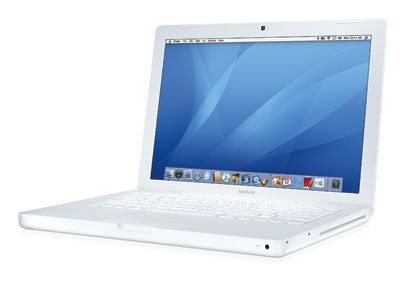
Announced in May 2006, The MacBook replaced the existing 12- and 14-inch iBooks and 12-inch MacBook Pro: a dual core Intel Core Duo processor, a faster 667 MHz bus speed, a faster and larger Serial-ATA hard drive, an integrated iSight camera, a MagSafe power adaptor, and a bundled remote control with Apple's Front Row Software. It also included some features previously found only on Apple's professional laptops: optical audio in/out, a DVI port capable of monitor-spanning, and Gigabit Ethernet. Two features unique to the MacBook were a magnetic latching system with no moving parts, and a resigned recessed keyboard. One potential drawback to the new MacBook was that its graphic chipset used a portion of main memory, resulting in less RAM available for system tasks. This was offset, however, by the MacBook's two RAM slots, which allowed the installation of up to 2 GB of memory.
The MacBook shipped in three configurations. The low-end model, with a 1.83 GHz Core Duo processor, 512 MB of RAM, a 60 GB hard drive, and a CD-RW/DVD-ROM Combo Drive, sold for $1,099. The middle-end model, with a 2.0 GHz Core Duo processor, 512 MB of RAM, a 60 GB hard drive, and a CD-RW/DVD±RW SuperDrive, sold for $1,299. Finally, a high-end model shipped in a black case (the first black Apple portable in more than five years). It improved upon the middle-end model with an 80 GB hard drive, and sold for $1,499. All models were replaced in November 2006 by the Mac Book (Late 2006). |
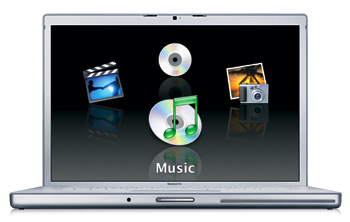
Announced in January 2006, the MacBook Pro was the first portable Mac to use Intel Processors. The name for Apple's professional portable was ostensibly changed from PowerBook because Apple felt that all Macintoshes should have "Mac" in their product names, but was probably chosen because the Mac Book Pro no longer used a PowerPC processor—Though the PowerBook name predates the use of PowerPC processors, it was used in the naming of the Power Macintosh line to differentiate it from the previous 68k Macs.
Though the MacBook Pro included a number of enhancements to the final iteration of the PowerBook G4—a thinner case, a built-in iSight camera, a remote control with Apple's Front Row home media center software, an ExpressCard/34 slot, improved wireless reception, a larger screen and the new "MagSafe" power connector designed to be less prone to damage—there were also some notable omissions. The MacBook Pro no longer included FireWire800, s-video or modem ports (a USB modem was available separately), and the slot-loading SuperDrive no longer supported dual-layer DVD+R media. Though it shipped with a Serial-ATA bus, the hard drive capacity was reduced from 120 GB to 80 or 100 GB. The big news, however, was that the MacBook Pro included a dual-core processor, a first for an Apple portable. Though announced at 1.67 and 1.83 GHz, the MacBook Pro actually shipped with 1.83 or 2.0 GHz Intel Core Duo processors, with a 2.16 GHz processor available as a BTO option. The MacBook Pro shipped in two configurations: 1.83 GHz/80 GB/$1999 and 2.0 GHz/100 GB/$2499. Both configurations were speed-bumped in May 2006 to 2.0 GHz and 2.16 GHz, respectively, and were made available with a glossy screen as a BTO option. It was replaced in October 2006 by the Mac Book Pro (Late 2006). |
| Picture Credit | Apple, Inc. | Apple, Inc. |